• The Works of Posada

    March 29th, 2025

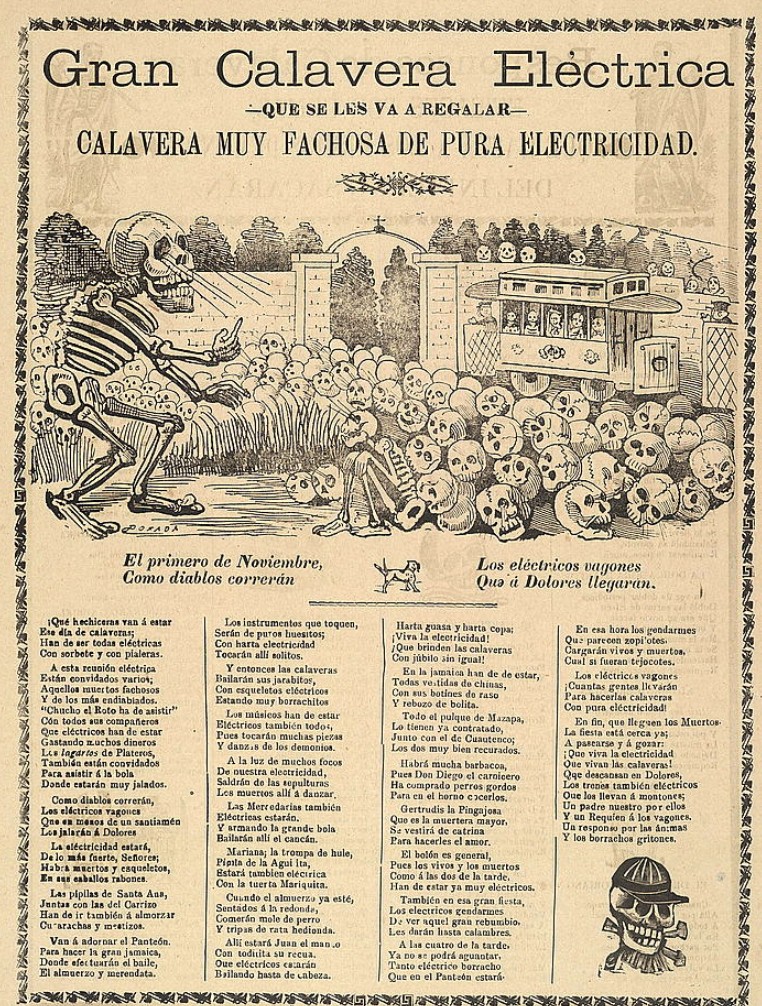
    The prints of José Guadalupe Posada (1852–1913) remain among the most iconic and influential examples of how popular culture became a vehicle for political and social critique in late 19th- and early 20th-century Mexico. Through his distinctive engravings and illustrations—widely circulated in broadsheets, pamphlets, and newspapers—Posada gave visual expression to the frustrations and hopes of Mexico’s working class, who bore the weight of Porfirio Díaz’s authoritarian modernization. His art offered not just entertainment, but sharp satire, often skewering the excesses of the bourgeoisie and exposing the deep injustices of Díaz’s regime. Posada’s images struck a chord with the public, weaving together acerbic commentary with elements of folk tradition, religious symbolism, and the vivid iconography of Day of the Dead calaveras—motifs he helped bring into popular consciousness. Though he died in poverty and relative obscurity, Posada’s influence far outlived him. He is now hailed as the “printmaker of the Mexican people,” a tribute to his deep connection with the humor, struggles, and resilience of everyday Mexicans. His prints not only captured a turbulent era in Mexican history but also paved the way for future generations of politically engaged artists—including the Mexican Muralists, such as Diego Rivera, who saw Posada as a foundational figure in the evolution of modern Mexican art. Consider the following questions as your read the selections below:

    • How does electricity represent progress or danger in this work?
    • What might Posada be saying about the role of technology in relation to life and death? Is it liberating, dehumanizing, or both?
    • How did political and social conditions during Porfirio Díaz’s regime influence Posada’s imagery in this piece?
    • What do you think the “American mosquito” symbolizes in this piece? Is it just a pest, or does it represent something more — like imperialism, capitalism, or foreign intervention?

    Complete the Primary Source Analysis Form when finished for your records.


    Great Electric Skeleton

    Subheading: The first of November, Like devils will run The electric street cars That go out to Dolores[cemetery in Mexico City].

    Verse 4: The electricity will be Of the strongest, señores, There will be dead folks and skeletons On their crop-tailed horses.

    Verse 10: Into the light of many lamps Lit by our electricity The dead there [at Dolores Cemetery] will emerge, From their tombs to dance.

    Verse 24: The electric street cars ¡So many people they’ll bringTo turn them into skeletons With pure electricity!
    The American Mosquito

    Subheading: The American Mosquito Has just now arrived; They say that it came to walk around On our Mexican soil.

    Verse 1: They say it started on Sunday Over there in Laredo, Texas, Biting on the ears Of some old women at the Station. It made them run around Until it made them sweat This inhuman beast: The American Mosquito.

    Verse 2: It proceeded on to Guanajuato, This is a laughable thing, It never made it to the center of town, But it was in Marfil. Now they suffer no more Such a rude and haughty thing, Why it bit an old soldier Right on his behind. Because it’s really very crude The American Mosquito.

    Verse 3: It went off toward Irapuato And passed through Pénjamo; From there it returnedThrough the village of Uriagato, The hacienda of Villachato It left all in shambles; All the people frightened As their buddy Mariano found them, Grandma Emeteria shouted: The American Mosquito.

    Verse 4: Through the ports of San Juan Piedra Gorda and la Sandía, An old woman said: “Jesus, what a ferocious beast!” Tell me Don Pascual Has the Mosquito arrived? They say it’s really tiny, And also very beastly; What does it say papa Pachito The American Mosquito?

  • Speech on Land Reform

    March 24th, 2025

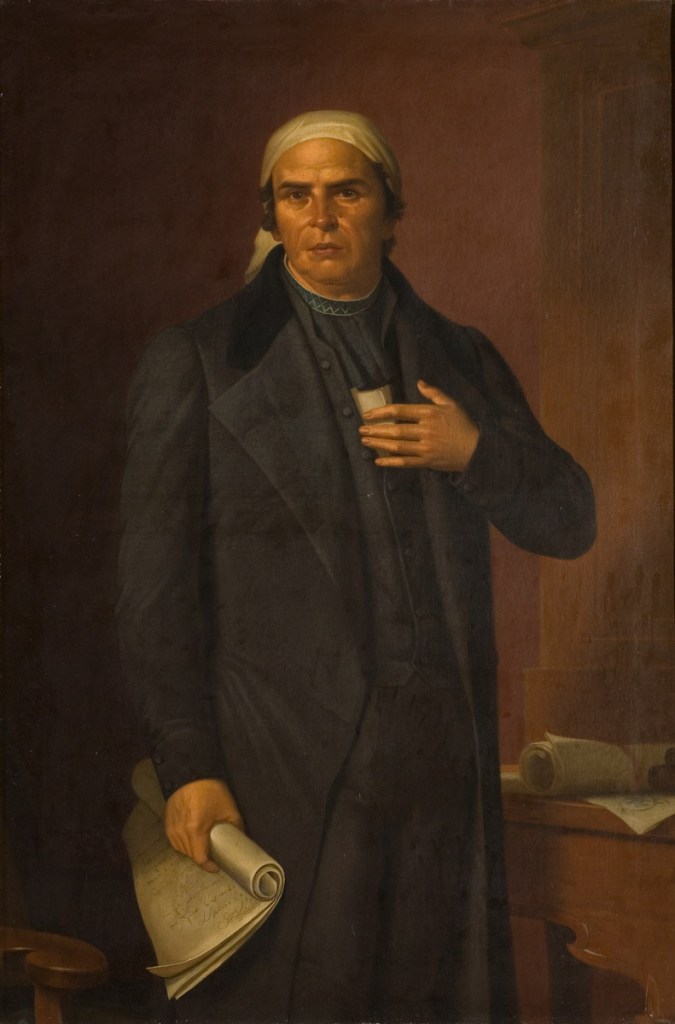
    José Francisco Ponciano Arriaga Leija (1811–1865) was a prominent liberal puro who played a significant role in shaping Mexico’s constitutional framework during a pivotal era of reform. As president of both the Asamblea Constituyente and the Comisión de Constitución, Arriaga was a vocal advocate for transformative change, particularly in addressing the deep-rooted issue of land inequality. Alongside other radical liberals, he championed the need for land reform as a means to dismantle the lingering vestiges of colonial privilege and empower the rural poor. While the full realization of these reforms would not occur during Arriaga’s lifetime, his advocacy laid crucial ideological groundwork. The demands for land redistribution would ultimately be brought to fruition decades later with the outbreak of the Mexican Revolution (1910–1920), where agrarian justice became one of the central rallying cries of the movement. Consider the following questions as your read the selections below:

    • How is the ownership of land distributed amongst Mexicans?
    • What recourse do the landless turn to?
    • What will the value of a new constitution be without land reform?
    • How is the peasantry exploited?

    Complete the Primary Source Analysis Form when finished for your records.


    Speech on Land Reform

    One of the most deeply rooted evils of our country— an evil that merits the close attention of legislators when they frame our fundamental law— is the monstrous division of landed property. While a few individuals possess immense areas of uncultivated land that could support millions of people, the great majority of Mexi-cans languish in a terrible poverty and are denied property, homes, and work. Such a people cannot be free, democratic, much less happy, no matter how many constitutions and laws proclaim abstract rights and beautiful but impracticable theories—
    impracticable by reason of an absurd economic system. There are Mexican landowners who occupy (if one can give that name to a purely imaginary act) an extent of land greater than the area of some of our sovereign states, greater even than that of one or several European states. In this vast area, much of which lies idle, deserted, aban-doned, awaiting the arms and labor of men, live four or five million Mexicans who know no other industry than agriculture, yet are without land or the means to work it, and who cannot emigrate in the hope of bettering their fortunes. They must either vegetate in idleness, turn to banditry, or accept the yoke of a landed monopolist who subjects them to intolerable conditions of life. How can one reasonably expect these unhappy beings to escape from their condition as abject serfs through legal channels, or hope that the magic power of a written law will transform them into free citizens who know and defend the dignity and importance of their rights?

    We proclaim ideas and forget realities; we launch on discussions of rights and turn away from stubborn facts. The constitution should be the law of the land, but we do not regulate or even examine the state of the land. . . . How can a hungry, naked, miserable people practice popular government? How can we proclaim the equal rights of men and leave the majority of the nation in conditions worse than those of helots or pariahs? How can we condemn slavery in words, while the lot of most of our fellow citizens is more grievous than that of the black slaves of Cuba or the United States? When will we begin to concern ourselves with the fate of the proletarians, the men we call Indians, the laborers and peons of the countryside, who drag the heavy chains of serfdom established not by Spanish laws— which were so often flouted and infringed— but by the arbitrary mandarins of the colonial regime? Would it not be more logical and honest to deny our four million poor Mexicans all share in political life and public offices, all electoral rights, and declare them to be things, not persons, establishing a system of government in which an aristocracy of wealth, or at most of talent, would form the basis of our institutions? For one of two things is inevitable: either our political system will continue to be dominated for a long time to come by a de facto aristocracy— no matter what our fundamental laws may say— and the lords of the land, the privileged caste that monopolizes the soil and profits by the sweat of its serfs, will wield all power and influence in our civil and political life; or we will achieve a reform, shatter the trammels and bonds of feudal servitude, bring down all monopolies and despotisms, end all abuses, and allow the fruitful element of demo-cratic equality, the powerful element of democratic sovereignty— to which alone authority rightfully belongs— to penetrate the heart and veins of our political institu-tions. The nation wills it, the people demand it; the struggle has begun, and sooner or later that just authority will recover its sway. The great word
    reform has been pro-nounced, and it is vain to erect dikes to contain those torrents of truth and light. . . . Is it necessary, in an assembly of deputies of the people, in a congress of representatives of that poor, enslaved people, to prove the unjust organization of landed property in the Republic, and the infinite evils that flow from it? . . . In the realm of a purely ideal and theoretical politics, statesmen discuss the organization of chambers, the division of powers, the assignment of jurisdictions and attributes, the demarcation of sover-eignties, and the like. Meanwhile other, more powerful men laugh at all that, for they know they are the masters of society, the true power is in their hands, they exercise the real sovereignty. With reason the people think that constitutions die and are born, governments succeed each other, law codes pile up and grow ever more intricate, “pronouncements” and “plans” come and go, but after all those changes and upheav-als, after so much disorder and so many sacrifices, no good or profit comes to the masses who shed their blood in the civil wars, who swell the ranks of the armies, who fill the jails and do forced labor on the public works, who, in fine, suffer all the misfortunes of society and enjoy none of its benefits.

    With some honorable exceptions, the rich landowners of Mexico (who rarely know their own lands, palm by palm), or the administrators or majordomos who represent them, resemble the feudal lords of the Middle Ages. On his seignorial land, with more or less formalities, the landowner makes and executes laws, administers justice and exercises civil power, imposes taxes and fines, has his own jails and irons, metes out punishments and tortures, monopolizes commerce, and forbids the conduct without his permission of any business but that of the estate.
    The judges or officials who exercise on the hacienda the powers attached to public authority are usually the master’s servants or tenants, his retainers, incapable of enforcing any law but the will of the master. An astounding variety of devices are employed to exploit the peons or tenants, to turn a profit from their sweat and labor. They are compelled to work without pay even on days traditionally set aside for rest. They must accept rotten seeds or sick animals whose cost is charged to their miserable wages. They must pay enormous parish fees that bear no relation to the scale of fees that the owner or majordomo has arranged beforehand with the parish priest. They must make all their purchases on the hacienda, using tokens or paper money that do not circulate elsewhere. At certain seasons of the year they are assigned articles of poor quality, whose price is set by the owner or majordomo, constituting a debt that they can never repay. They are forbidden to use pastures and woods, firewood and water, or even the wild fruit of the fields, save with the express permission of the master. In fine, they are subject to a completely unlimited and irresponsible power.

  • Sentiments of a Nation

    March 24th, 2025

    José María Morelos y Pavón

    The political ideals of José María Morelos y Pavón are most clearly articulated in his seminal document, Sentiments of the Nation (Sentimientos de la Nación), delivered in 1813 during the Congress of Chilpancingo. Drawing inspiration from both the principles of the European Enlightenment and the socio-political realities of colonial Mexico, Morelos envisioned a sovereign nation rooted in justice, equality, and popular representation. His proposals included the abolition of slavery, the elimination of caste-based distinctions, and the redistribution of wealth—radical ideas for their time. Although Morelos was ultimately unable to unify the various factions within the independence movement or achieve political consensus, Sentiments of the Nation left a lasting imprint on Mexico’s legal and constitutional development. It laid the ideological groundwork for later liberal reforms and helped shape the national vision of a republic founded on civil liberties and social equity. Consider the following questions as your read the selections below:

    • What kind of government did Morelos envision for Mexico?
    • What role did the Roman Catholic Church have in the Mexico Morelos envisioned?
    • How were citizenship, rights, and obligations to be determined in Mexico as stipulated in Sentiments of a Nations
    • Did you find elements of liberalism and conservatism housed in Sentiments of a Nation?

    Complete the Primary Source Analysis Form when finished for your records.


    Sentiments of the Notion or
    Points Outlined by Morelos for the Constitution

    1. That America is free and independent of Spain and of all other Nations, Governments, or Monarchies, and it should be so sanctioned, and the reasons explained to the world.
    2. That the Catholic Religion is the only one, without tolerance of any other.
    3. That all the ministers of the Church shall support themselves exclusively and entirely from tithes and first-fruits (primicias), and the people need make no offering other than their own devotions and oblations.
    4. That Catholic dogma shall be sustained by the Church hierarchy, which consists of the Pope, the Bishops and the Priests, for we must destroy every plant not planted by God: minis plantatisquam nom plantabir Pater meus Celestis Cradicabitur. Mat. Chapt. XV.
    5. That sovereignty springs directly from the People, who wish only to deposit it in their representatives, whose powers shall be divided into Legislative, Executive, and Judiciary branches, with each Province electing its representative. These representatives will elect all others, who must be wise and virtuous people . . .
    6. [Article 6 is missing from all reproductions of this document.]
    7. That representatives shall serve for four years, at which point the oldest ones will leave so that those newly elected may take their places.
    8. The salaries of the representatives will be sufficient for sustenance and no more, and for now they shall not exceed 8,000 pesos.
    9. Only Americans shall hold public office.
    10. Foreigners shall not be admitted, unless they are artisans capable of teaching [their crafts], and are free of all suspicion.
    11. That the fatherland shall never belong to us nor be completely free so long as the government is not reformed. [We must] overthrow all tyranny, substituting liberalism, and remove from our soil the Spanish enemy that has so forcefully declared itself against the Nation.
    12. That since good law is superior to all men, those laws dictated by our Congress must oblige constancy and patriotism, moderate opulence and indigence, and be of such nature that they raise the income of the poor, better their customs, and banish ignorance, rapine, and robbery.
    13. That the general laws apply to everyone, without excepting privileged bodies, and that such bodies shall exist within accordance with the usefulness of their ministry.
    14. That in order to dictate a law, Congress must debate it, and it must be decided by a plurality of votes.
    15. That slavery is proscribed forever, as well as the distinctions of caste, so that all shall be equal; and that the only distinction between one American and another shall be that between vice and virtue.
    16. That our ports shall be open to all friendly foreign nations, but no matter how friendly they may be, foreign ships shall not be based in the kingdom. There will be some ports specified for this purpose; in all others, disembarking shall be prohibited, and 10% or some other tax shall be levied upon their merchandise.
    17. That each person’s home shall be as a sacred asylum wherein to keep property and observances, and infractions shall be punished.
    18. That the new legislation shall forbid torture.
    19. That the Constitution shall establish that the 12th of December be celebrated in all the villages in honor of the patroness of our liberty, the Most Holy Mary of Guadalupe. All villages shall be required to pay her monthly devotion.
    20. That foreign troops or those of another kingdom shall not tread upon our soil unless it be to aid us, and if this is the case, they shall not be part of the Supreme Junta.
    21. That there shall be no expeditions outside the limits of the kingdom, especially seagoing ones. Expeditions shall only be undertaken to propagate the faith to our brothers in remote parts of the country.
    22. That the great abundance of highly oppressive tributes, taxes, and impositions should be ended, and each individual shall pay five percent of his earnings, or another equally
      light charge, which will be less oppressive than the alcabala [sales tax], the estanco [crown monopoly], the tribute, and others. This small contribution, and the wise administration of the goods confiscated from the enemy, shall be sufficient to pay the costs of the war and the salaries of public employees.
    23. That the 16th of September shall be celebrated each year as the anniversary of the cry of independence and the day our sacred liberty began, for on that day the lips of the Nation parted and the people proclaimed their rights, and they grasped the sword so that they would be heard, remembering always the merits of the great hero, señor don Miguel Hidalgo y Costilla, and his compañero, don Ignacio Allende.

    Chilpancingo, 14 September 1813

  • The Book of Tributes

    March 17th, 2025

    Diego Valadés, illustration of preaching to the Indigenous population in New Spain, from Rhetorica christiana ad concionandi et orandi vsvm accommodata, 1579.

    The effectiveness of the mendicant orders in converting and baptizing Native Americans depends largely on the sources consulted. Consider, for example, Fray Diego Durán’s observations on the success of the “Spiritual Conquest.” In contrast, Native American sources challenge the extent to which the regular clergy succeeded in converting Indigenous peoples. Below are census records from Morelos dating between 1535 and 1540, a period when this region of Mexico was a central focus of the Spiritual Conquest. These records provide historians with valuable insights into household composition and the presence of Christianity within these communities. As you analyze these documents, consider what they reveal about Native American households. Consider the following questions:

    • What is the typical size of a tlatoani’s household, and who comprises it?
    • How does this compare to the size and composition of a commoner’s household?
    • What indicators of baptism can be identified in these sources?
    • How many members of a tlatoani’s household were baptized compared to those in a commoner’s household?
    • If there is a difference, what might explain it?
    • Finally, based on these documents, how effective was the Spiritual Conquest in Morelos? Beyond baptism, what additional insights do these records provide about Nahua households and their social structures?

    Complete the Primary Source Analysis Form when finished for your records.


    THE BOOK OF TRIBUTES (Selections)

    The ruler of the city-state of Huitzillan’s household

    Here is an altepetl (city-state) whose name is Huitzillan […] [There are] [six?] groups of calpulli (kinship/residence group) members. Here is the one who governs there, the tlatoani [ruler] whose name is Don Tomás […]zatzin.

    Here is his wife, whose name is Doña* María Tonallaxochiatl. Here are his children, seven of them. The first one is named Ana Tlaco, now ten years old. The second is named María Xocoyotl, now nine years old. The third is named Magdalena Tlaco, now eight years old. Here is the fourth, named Pedro Tecue[…], now seven years old. The fifth is named Pedro Omoacatl, now six years old. Here is the seventh, named Cocoliloc, now four years old. -Here is another of his children [separately engen-dered?], not baptized, named Cocoyotl, now two years old. Here are the concubines of Don Tomás, […] six of them. The first is named María Tlaco, the second is named Marta Xoco. The third, not yet baptized, is named Teicuh. The fourth, not baptized, is named Teicuh [sic]. The fifth, not baptized, is named Necahual. The sixth, baptized, is named Magdalena Teya[ca]pan.

    Here are the dependents of the tlatoani Don Tomás. The first dependent person is not baptized, named Necahualli, a widow; three years ago her husband [died]. She has [two?] children. [The first?], not baptized, is named Teyacapa […] years old. [The second], not baptized, is named Ichpocton, now three years old. Here is the second dependent [of the tlatoani], named Xoco, now [ten years old?]. Here are the fields of Don Tomás, 800 [units of measure] of lordly land. And here is his tribute: every 80 days he delivers five Cuernavaca cloaks, [one good?] embroidered skirt, a thick tribute garment, no provisions of food, et cetera [sic]. In the residence of the tlatoani Don Tomás there are 20 people who are included in the tecpan [palace].”

    Typical household in Huitzillan

    Here is the home of one named Tomiyauh, not baptized. His wife is named Teicuh, not baptized. They have had no children. Here are his four younger siblings. The first is named Poton, not baptized. He has taken a wife. His wife is named Necahual, not baptized. They do not yet have children. They were married not long ago. The second of his younger siblings is named Acol, not baptized, born ten years ago. The third of his younger siblings is named Teicuh, not baptized. She is married. Her husband is named Huehuetl, not baptized. The fourth is named Xoco, not baptized, born seven years ago. Tomiyauih’s mother […], just an old woman. Here is one he maintains, named Teyacapan, not baptized. Her home is not far, there [i.e., nearby]. Here is his field: 20, 15 matl [unit of measure] wide. Here is his tribute: every 80 days he delivers on quarter-length of a cloak, so that in one year it is one whole Cuernavaca cloak. Here is his provisions tribute: one quarter-length of a narrow cloak, so that in one year it is one whole one; no tribute cloaks. That is all of his tribute. In addition, his younger siblings look for cotton [for?] his tribute. Ten are included; they are in one house.

  • Las Siete Partidas: Laws Concerning Warfare and the Military

    March 3rd, 2025

    Cantigas de Santa Maria – Warfare

    Las Siete Partidas is a landmark legal code compiled in 13th-century Castile during the reign of King Alfonso X, known as Alfonso the Wise (r. 1252–1284). Written between 1256 and 1265, this extensive legal text sought to unify and standardize the kingdom’s laws by drawing upon Roman, Visigothic, and canon law traditions. Comprising seven distinct sections—hence the name Siete Partidas—the code addresses a wide range of legal matters, including governance, civil and criminal law, family relations, commerce, and religious affairs. Although Las Siete Partidas was not immediately enforced upon completion, it went on to become one of the most influential legal texts in Spain and its territories, particularly in colonial Latin America. It shaped Spanish legal traditions for centuries and remained a key reference in the Spanish-speaking world well into the modern era. The code reflects Alfonso X’s vision of a centralized monarchy and underscores the role of law in maintaining order and justice. Today, Las Siete Partidas stands as a crucial resource for understanding medieval Iberian law, governance, and culture. Consider the following questions as you read the selections below:

    • According to the passage, what are the three justifications for war?
    • How does the passage reflect the concept of the divine right of kings or the idea that rulers have a moral obligation to wage just wars?
    • The passage distinguishes between two types of war—one against internal enemies and one against external enemies. How does the reasoning behind each differ, and what does this suggest about medieval perspectives on governance and security?

    Complete the Primary Source Analysis Form when finished for your records.


    Title XXIII – Concerning the War which all Persons on Earth should engage in

    War is of two kinds one bad, the other good. And although each of these can be divided with relation to the deeds to which it gives rise, nevertheless, so far as the name and the manner of making it are concerned, both are one and the same thing; for engaging in hostilities, although it involves destruction and the inciting of dissensions and enmity among men, yet, when, it is carried on as it should be, it afterwards brings peace, from which result quiet, rest and friendship. For this reason the ancient sages declared that it was well for men to endure the hardships and dangers of war, because, by this means they eventually obtain beneficial peace and rest; and since the evil inherent in it is productive of good results, and on account of the mistrust which compels men to engage in war, those who desire to inaugurate it should be well informed before they begin.

    Wherefore, since in the preceding Title we have spoken separately of knights and commanders, and of the things which they are required to observe and do, we intend to show here in the laws of this Title what wars it is proper both should engage in with consideration of the two different advantages which may be obtained by their country through war; first, by learning how to protect and defend it from its enemies; second, how to aggrandize, it by obtaining their property. In the first place, we shall show what war is; how many kinds there are; for what reasons it should be made; with what things those who desire to make it should be provided and equipped; what kind of men those who are selected to act as commanders in the war should be; what they should do and observe; how all the rest of the people should be governed by them; and what benefit arises from this control. We shall also show how many kind of bodies of troops there are; and how they should be divided when they have to invade a country or go into battle; and also how the officers should be vigilant while in command of an army when it marches from one place to another, or when they select a camp for the night, or desire to lay siege to a town or castle; and, above all, we shall speak of foraging parties, ambuscades, forays, and all the other kinds of hostilities which men engage in.

    Law I – What War Is, and How Many Kinds There Are

    The ancient sages who treated of the subject of war stated that it is hos­tility to peace, the motion of things that are quiet, and the destruction of things that are complex. They also described war as something from which proceeds the death and captivity of men, and the injury, loss, and ruin of property. There are four kinds of war. The first is called justa, in Latin, which means, in Castilian, founded upon right. This happens where a man engages in it to recover his own property from the enemy, or to protect himself and it from them; the second is called, in Latin, injusta, which means a war instituted through pride, and contrary to what is right. The third is called civilis, which means one which arises among the inhabitants of a certain locality, as among factions, or in a kingdom on account of some disagreement which the people have among themselves. The fourth is called plusquam civilis, which means a war in which not only the citizens of some locality contend with one another, but also where relative is arrayed against relative, by reason of faction; as was the case with Caesar and Pompey, who were respectively father-in-law and son-in-law, And in which war Romans fought, fathers against their sons, and brothers against their brothers, some of them support­ing Caesar and others Pompey.

    Law II – For What Reasons Men Are Impelled to Make War

    The inauguration of war, is something which those who wish to, make it should carefully consider before they begin, in order that it may be carried on with reason and justice, for, by doing this, three great advantages are obtained; first, God will afford greater assistance to those who institute it in this manner; second, they will exert themselves more strongly on account of their being in the right; third, those who hear of it, if they are friendly, will assist them with greater good will, and if they are hostile, will withdraw themselves more from them. The right to maintain a just war, is as the ancient sages explained, based upon three considerations; first, to expand the religion of the People, and to destroy those who wish to oppose it; second, for the sake of their lord, by desiring loyally to serve, honor, and defend him; third, in order to protect themselves and aggrandize and honor the country in which they dwell.

    A war of this kind should be made in two ways, namely; one on enemies who are within the kingdom, who are doing harm to the country by robbing and unjustly depriving men of their property – for kings and those who have the right to sit in judgment should oppose such as these, and see that justice is executed upon them and the whole body of the people should fight them, in order to eradicate and expel them. For, as wise men stated, persons of this kind are malefactors in the kingdom, and resemble poison in the body of a man, who cannot be well as long as it is there. Wherefore, it is proper that war should be carried on with men of this kind, by pursuing them and inflicting upon them as much injury as possible until they are driven from the kingdom or killed, (as we stated above in the laws of the Title treating of this subject,) in order that the people who inhabit the land may be able to live in peace. The second kind of war of which we intend to speak here, is that which is carried on with enemies outside the kingdom, who desire to deprive the people of their country by force, and for the purpose of protecting them in what they should justly possess. We desire to show how this kind of war should be made, as established by the ancient sages, who, as well as other knights, thoroughly understood it, because they were well informed on the subject through their own operations and practice during a long period of time.

  • Human Sacrifice Among the Aztecs?

    February 8th, 2025

    Peter Hassler – University of Zurich


    An aura of lurid fascination surrounds our interest in the Aztecs, the people who, at the beginning of the
    16th century, inhabited one of the largest cities of the world: Tenochtitlan. In 1521, this metropolis was
    erased from the face of the Earth by the Spanish conquerors under Hernando Cortes and his Indian allies.
    As a justification for their destructive acts, the conquistadors generated propaganda designed to offend the sensibilities of their Christian audience: They described the Aztec practice of human sacrifice. Later
    chronicles by Spanish writers, missionaries, and even Indian converts also told repeatedly of this cult.
    Even when scientists called these reports grossly exaggerated, the fact that the Aztecs sacrificed humans remained undisputed. Cutting out the victim’s heart with an obsidian knife [fashioned from volcanic glass] was supposedly the most common method of sacrifice, although other forms were practiced as well. These included beheading, piercing with spears or arrows, and setting victims against each other in unequal duels. We are also told that some victims were literally skinned alive; a priest then donned this macabre “skin suit” to perform a ritual dance.

    There has been no shortage of theories and explanations for what lay behind these archaic cults. Some researchers have deemed them religious rituals. Others have called them displays of repressed aggression and even a method of regulating population. Although human sacrifice has been the subject of much writing, there has been almost no critical examination of the sources of information about it. A critical review is urgently needed.

    Bernal Diaz del Castillo is the classic source of information about mass sacrifice by the Aztecs. A literate
    soldier in Cortes’ company, Diaz claimed to have witnessed such a ritual. “We looked over toward the
    Great Pyramids and watched as [the Aztecs] … dragged [our comrades] up the steps and prepared to
    sacrifice them,” he wrote in his Historia Verdadera de la Conquista de la Nueva Espana (The True History
    of the Conquest of New Spain), published posthumously in 1632. “After they danced, they placed our
    comrades face up atop square, narrow stones erected for the sacrifices. Then, with obsidian knives, they
    sawed their breasts open, pulled out their still-beating hearts, and offered these to their idols.”

    The scene of these sacrificial rituals was the main temple in the island-city of Tenochtitlan. The
    observers, however, were watching from their camp on the shore of a lake three or four miles away. From
    that point, Diaz could have neither seen nor heard anything. To follow the action at the foot of the
    pyramid, he would have to have been inside the temple grounds. But this would have been impossible:
    The Aztecs had just beaten back the Spanish and their allies, who had been besieging the city from all
    sides.

    But Diaz is not the inventor of the legend of ritual murder. Cortes fathered the lie in 1522, when he wrote
    a shorter version of the tale to Emperor Charles V. He would have been confident that his reports would find ready ears, for in the 15th and 16th centuries many lies were being spread in Spain about ritual
    murders carried out by the Jews, who were being expelled from the Iberian peninsula along with the
    Moors. Cortes’ lies were a tremendous success: They have endured for almost 500 years without
    challenge. Along with the lies of the conquistadors, there also have been secondhand reports–what could be called “hearsay evidence”–in the writings of Spanish missionaries and their Indian converts, who, in their new-found zeal, scorned their old religion. The accounts are filled with vague and banal phrases such as, “And thus they sacrificed,” which indicates that the writers cannot have witnessed a real human sacrifice.

    The only concrete evidence comes to us not from the Aztecs but from the Mayan civilization of the
    Yucatan. These depictions are found in the records of trials conducted during the Inquisition, between
    1561 and 1565. These supposed testimonies about human sacrifice, however, were coerced from the
    Indians under torture and have been judged worthless as ethnographic evidence.

    Along with the written accounts, many archeological finds–sculptures, frescoes, wall paintings, and
    pictographs–have been declared by the Spanish, their Indian converts, and later anthropologists to be
    connected to human sacrifice. Yet these images are in no way proof that humans were in fact sacrificed.

    Until now, scientists have started from a position of believing the lies and hearsay reports and interpreting the archeological evidence accordingly. The circularity of such reasoning is obvious. There are plenty of possible interpretations of the images of hearts and even killings in these artifacts. They could depict myths or legends. They could present narrative images–allegories, symbols, and metaphors. They could even be images of ordinary executions or murders. Human bones that appear to have been cut also do not serve as evidence of human sacrifice. In tantric Buddhism, skulls and leg bones are used to make musical instruments used in religious rituals; this is in no way connected to human sacrifice.

    Leslie J. Furst, a student of symbols used by the Aztecs, has seen depictions of magic where others have seen tales of human sacrifice. For example, one image shows the incarnation of a female god “beheaded” in the same way that a plant’s blossom is removed in the ritual connected to the making of pulque, an alcoholic drink. Why scholars have interpreted images of self-beheadings and other things that depart from physical reality as evidence of human sacrifice will puzzle future generations.

    There is another important symbolic background for images of killing in Aztec artifacts: the initiation
    ceremony, whose central event is the mystical death. The candidate “dies” in order to be reborn. This
    “death” in imaginary or symbolic forms often takes on a dramatic shape in imagery–such as being
    chopped to pieces or swallowed by a monster. There has been no research into the symbolism of death in
    the high culture of the Indians of Mesoamerica, however, even though there were many reincarnation
    myths among these peoples.

    The ritual of “human skinning” surely belongs in this same category. In our depictions, we see the skin
    removed quickly from the victim, with a single cut along the spine, and coming off the body in a single
    piece. This is scarcely practicable. This “human skin suit” may be nothing but a metaphorical-symbolic
    representation, as indeed is appropriate for the image-rich Aztec language. And all of the heart and blood
    symbolism may be just a metaphor for one of the Aztecs’ favorite drinks, made from cacao.

    The heart is a symbolically important organ in more than just European cultures. In the Indian languages,
    as well, it is a symbol of courage and the soul. And “cutting the soul from the body,” after all, is not a
    surgical operation. This may explain why no massive catacombs with what would have been the bones of
    sacrifice victims have ever been found in Mesoamerica.

    After careful and systematic study of the sources, I find no sign of evidence of institutionalized mass
    human sacrifice among the Aztecs. The phenomenon to be studied, therefore, may be not these supposed sacrifices but the deeply rooted belief that they occurred.


    Source: From the liberal weekly “Die Zeit” of Hamburg. Peter Hassler, an ethnologist at the University of Zurich, is the author of “Human Sacrifice Among the Aztecs? A Critical Study,” published recently in Switzerland

  • Legend of the Four Suns

    February 7th, 2025

    The Legend of the Four Suns is one of the most significant surviving texts detailing Nahua cosmology, offering a comprehensive account of the universe’s origins and evolution. Equally important, it presents a cyclical view of time, describing the successive ages the earth has undergone. According to this tradition, four previous suns—or eras—preceded the current one. In addition to the Legend of the Four Suns, the Aztec Calendar Stone also records these four previous ages, prominently depicted at its center (see image above). Consider the following questions as you analyze this source:

    • What is the purpose of cosmologies?
    • How were the different ages in Nahua cosmology created and destroyed?
    • What insights does this cosmology provide about Nahua culture?

    Complete the Primary Source Analysis Form when finished for your records.


    The Legend of the Four Suns

    Here is the oral account of what is known of how the earth was founded long ago.
    One by one, here are its various foundations [ages].

    How it began, how the first Sun had its beginning 2513 years ago—thus it is known today, the 22
    of May, 1558.
    This Sun, 4-Jaguar, lasted 676 years.
    Those who lived in this first Sun were eaten by ocelots. It was the time of the Sun 4-Jaguar.
    And what they used to eat was our nourishment, and they lived 676 years.
    And they were eaten in the year 13.
    Thus they perished and all ended. At this time the Sun was destroyed.
    It was on the year 1-Reed. They began to be devoured on a day [called] 4-Tiger. And so with this
    everything ended and all of them perished.

    This Sun is known as 4-Wind.
    Those who lived under this second Sun were carried away by the wind. It was under the Sun 4-
    Wind that they all disappeared.
    They were carried away by the wind. They became monkeys. 13. Their homes, their trees everything was taken away by the wind.
    And this Sun itself was also swept away by the wind.
    And what they used to eat was our nourishment.
    [The date was] 12-Serpent. They lived [under this Sun] 364 years.
    Thus they perished. In a single day they were carried off by the wind. They perished on a day 4-
    Wind.

    The year [of this Sun] was 1-Flint.
    This Sun, 4-Rain, was the third.
    Those who lived under this third Sun, 4-Rain, also perished. It rained fire upon them. They
    became turkeys.
    This Sun was consumed by fire. All their homes burned.
    They lived under this Sun 312 years.
    They perished when it rained fire for a whole day.
    And what they used to eat was our nourishment.
    [The date was] 7-Flint. The year was 1-Flint and the day 4-Rain.
    They who perished were those who had become turkeys.
    The offspring of turkeys are now called pípil-pípil.

    This Sun is called 4-Water; for 52 years the water lasted.
    And those who lived under this fourth Sun, they existed in the time of the Sun 4-Water.
    It lasted 676 years.
    Thus they perished: they were swallowed by the waters and they became fish.
    The heavens collapsed upon them and in a single day they perished.
    And what they used to eat was our nourishment.
    [The date was] 4-Flower. The year was 1-House and the day 4-Water.
    They perished, all the mountains perished.
    The water lasted 52 years and with this ended their years.

    This Sun, called 4-Movement, this is our Sun, the one in which we now live.
    And here is its sign, how the Sun fell into the fire, into the divine hearth, there at Teotihuacán.
    It was also the Sun of our Lord Quetzalcóatl in Tula.
    The fifth Sun, its sign 4-Movement.
    Is called the Sun of Movement because it moves and follows its path.
    And as the elders continue to say, under this sun there will be earthquakes and hunger, and then
    our end shall come


    Source: León-Portilla, Miguel. Aztec Thought and Culture: A Study of the Ancient Nahuatl Mind. University of Oklahoma Press.

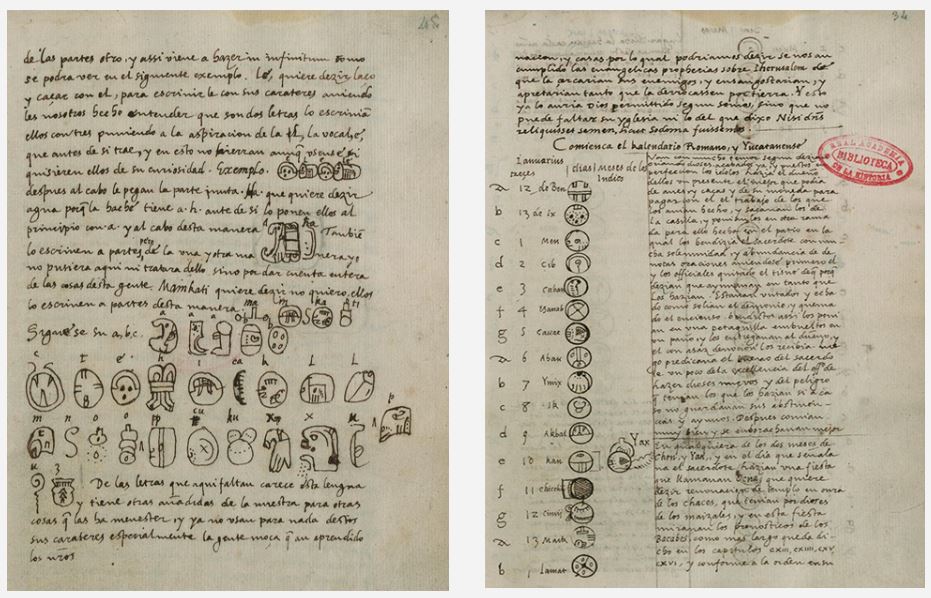
  • Fray Diego Landa: Relación de las Cosas de Yucatán

    February 7th, 2025

    Fray Diego de Landa’s Relación de las Cosas de Yucatán (1566) is a pivotal historical and ethnographic account of the Maya civilization, written during the Spanish colonization of the Yucatán Peninsula. As a Franciscan missionary, Landa meticulously documented Maya culture, language, religious practices, and daily life. However, he is also infamous for orchestrating the 1562 auto-da-fé in Maní, which led to the destruction of Maya codices and religious artifacts. Despite this contradiction, his work remains an invaluable resource, offering crucial insights into Maya glyphs and traditions that later contributed to the decipherment of the Maya script. Notably, Landa’s original Relación de las Cosas de Yucatán has never been found. The version that survives today is an abridged copy, transcribed by unidentified bureaucrats. This preserved text remains a key source on the Maya calendar and writing system, ensuring that some of Landa’s observations endure despite the loss of the original manuscript. As you analyze this selection from the abridged manuscript, consider the following questions:

    • According to Landa, what materials did the Maya write on?
    • What happened to many of these works?
    • How does Landa describe the workings of the Maya writing system?
    • Use these questions to guide your analysis as you engage with the text.

    Complete the Primary Source Analysis Form when finished for your records.


    Relación de las Cosas de Yucatán

    These people also used certain characters or letters with which they wrote in their books their
    ancient affairs and their sciences, and with these and with figures and some signs in the figures,
    they understood their affairs and they made others understand them and taught them. We found
    among them a large number of books in these their letters, and because they had nothing in
    which there was not superstition and lies of the devil, we burned them all, which they regretted
    to an amazing degree and which caused them sorrow. Of their letters I will give here an A, B, C,
    since their ponderousness permits nothing more, for they use one character for all the aspirations
    of the letters and, later, they unite with it part of another and thus it goes on ad infinitum, as will
    be seen in the following example. le means noose and to hunt with it; to write le with their
    characters (we having made them understand that these are two letters), they wrote it with three,
    placing for the aspiration of I the vowel e, which it carries in front of it, and in this way they do
    not err even though they might use [another] e if, out of curiosity, they so wish. Example:

    Afterwards, at the end, they affix the part which is joined. Ha means water, and because the h
    has a before it, they put it at the beginning with, and at the end in this fashion:

    They also wrote in parts, but in one way or another that I shall not give here nor will I deal with
    it except by giving a full account of this people’s affairs. Ma in kati means I don’t want to and
    they write it in parts in this fashion:

    There follows their A, B, C:

    Of the letters which are missing, this language lacks them and has others added from our own for
    other things of which it has need, and already they do not use these their characters at all,
    especially the young people who have learned ours.


    Source: Coe, Michael D. Breaking the Maya Code (Third Edition) (Kindle Locations 1797-1805). Thames & Hudson. Kindle Edition.

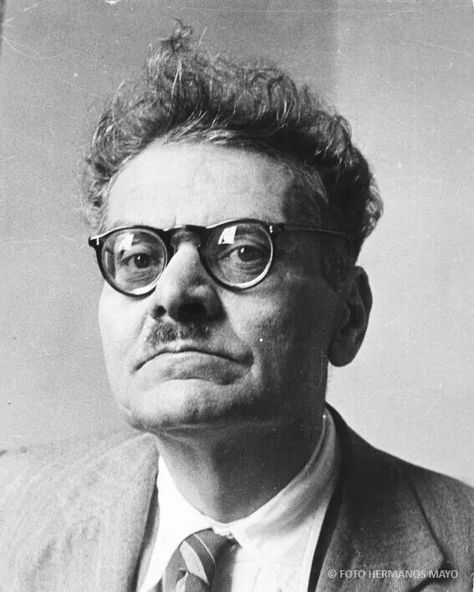
  • Long Live Land and Liberty

    November 17th, 2024

    Ricardo Flores Magón (1873–1922) was a prominent Mexican activist, journalist, and political reformer, renowned for his fierce opposition to the dictatorship of Porfirio Díaz. In 1900, he founded Regeneración, an influential newspaper that served as a powerful platform for denouncing the regime and championing social justice. His uncompromising activism led to repeated imprisonments under Díaz’s rule. While in exile in the United States, Magón co-founded the Mexican Liberal Party (PLM), advancing anarchist and revolutionary ideals. He remained committed to his cause until his death under suspicious circumstances at Leavenworth Penitentiary in Kansas in 1922. Today, Magón is remembered as a foundational thinker and ideological forerunner of the Mexican Revolution. Consider the following questions when reading the selection below:

    • What has been changed by La Revolución?
    • What has been gained by workers through La Revolución?
    • Who has benefitted from La Revolución?

    Complete the Primary Source Analysis Form when finished for your records.


    That afternoon dies without specific peculiarity. The sun, lazy, did not want to spread his golden hair in all the circumference of the horizon, as if he would be upset from the baseness of men, that because of their smallness they kill each other, because of nothing they suffer, and from nothing they are amused, like poor worms.

    Through the dusty highway–and dusty, too–an older man walks. It must have been a long journey, judging by the reflected tired face and his painful walk. He carries a backpack, a shirt, made of bleached cotton, perhaps, and worn out pants. It is a soldier returning home from the Orozco group.

    The man walks and walks, walks observing the groups of men and women assiduously, working in their eternal labor, dressed in very humble clothes, with sadness and desperation showing in their sunburned faces. These people work the same, dress the same, have the same look than before the revolution.

    The revolutionary stops to contemplate the picture and questions, “Why did we have the
    revolution?”

    And he continues walking to his village where he will see his loved ones, waiting for him anxiously, for sure, children and wife, after his long absence. The highway is slowly covered by shadows. To his side walks a group of workers marching towards their shacks, with the same looks of weariness, of fatigue, and maybe resentment. The revolutionary turns to the group and asks, “Why did we have the revolution?”

    He continues walking towards the village, where he will find his loved ones, where they are
    waiting desperately after a long wait, his children and wife.

    The barking of dogs denounces the proximity of the village completely submerged in darkness.

    The wind weeps between the branches of ash trees burdening the road. Our traveler walks,
    walks, and walks, thinking about his loved ones…

    The next day the revolutionary has to go back to the furrow, as any other one to make 25 to 50 cents a day; and if Vazquez Gómez has gotten the presidential chair, the poor keep on being poor, keep on being humiliated by the rich and by the authority.

    The revolutionary reflects and questions, “Why did we have the revolution?”

    Worn out, he returns to his shack, where he had been the night before. A pot of beans is their dinner, with a few tortillas. The dog yawns close to the fire; crickets sing their love in the cracks; children sleep almost naked. “Who won?” asks his wife, who is so happy to be able to stretch and hug her absent husband’s arms, and had not been able to ask the question before. After a few minutes, thinking, the revolutionary answers,

    “Well, we did.”

    “But you have not even a cent.”

    “Well anyhow, we son–we dethroned Madero.”

    “But we were left down, as always,” says the woman.

    The revolutionary scratches his hair and, not having any other way to answer,and answering as before, he questions, “Why did we have a revolutionary?”

    “Why did we have the Revolution?” the woman asks.

    And the revolutionary, surprised of this woman thinking like him, could not stand his indignation anymore, backing inside and exclaimed, “The revolution is only for the bold ones, the ones who want to be in the government, the ones who want to live off of the work of others! “

    We got furiously obstinate by not listening to the anarchists of Regeneration, who in all ways
    have advised us not to follow the employers, to take possession of the land, water, fields, mines, the factories, mills, miner, means of transportation, and that we should commune property to all the population of the Mexican Republic and so, we would consume what we produced. We were told that to struggle to elevate individuals was a criminal offense. We did not listen, because they were poor, from our own class, and as the saying goes, we carry penitence from our own sins. This is what we deserve, for being stupid! Our employers are having a great time right now, while we, the bait, the suckers, the ones who work, sweat, and struggle, show our chests to the enemy; now we are the ones who suffer more than before… Juan sounds the trumpet, announcing a meeting; rubs his eyes…It was a bad dream! Picks up his rifle, and rejoices, knowing the fact he’s joining the lines of the red flag liberators, and yells with sound voice, “Hail to my laud and freedom!”

    (From “Regeneración,” number 87, dated April 27, 1912.)

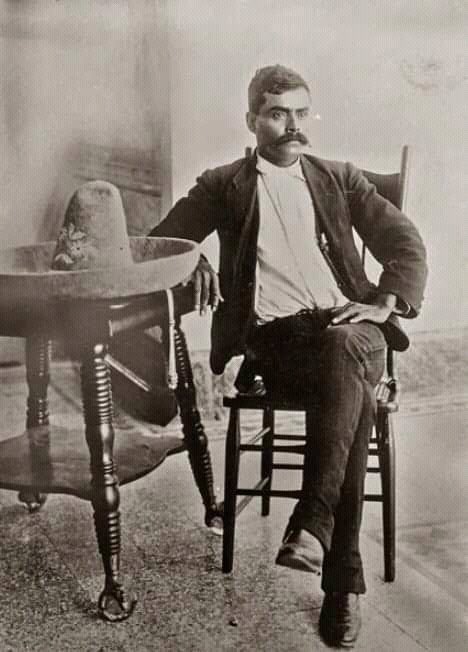
  • El Plan de Ayala

    November 17th, 2024

    The promise of meaningful land reform stirred hope across Mexico, inspiring countless peasants and rural communities to rally behind La Revolución in pursuit of justice and rightful ownership of the land they toiled on. But after ascending to power, President Francisco Madero failed to fulfill his pledges of agrarian reform, leaving many disillusioned. Feeling betrayed, revolutionary leader Emiliano Zapata responded with the bold and uncompromising Plan de Ayala—a fierce manifesto that demanded the redistribution of land and fiercely denounced Madero’s leadership. Consider the following questions as you read the source below:

    • How is Francisco Madero portrayed in this plan?
    • Who does Zapata recognize as the legitimate leader of Mexico?
    • What demands does Zapata make through this plan?

    Complete the Primary Source Analysis Form when finished for your records.


    Liberating Plan of the sons of the State of Morelos, affiliated with the Insurgent Army that defends the fulfillment of the Plan of San Luis, with the reforms which it has believed proper to add in benefit of the Mexican Fatherland. We who undersign, constituted in a revolutionary junta to sustain and carry out the promises which the revolution of November 20, 1910, just past, made to the country, declare solemnly before the face of the civilized world which judges us and before the nation to which we belong and which we call [sic, love], propositions which we have formulated to end the tyranny which oppresses us and redeem the fatherland from the dictatorships which are imposed on us, which [propositions] are determined in the following plan:

    1. Taking into consideration that the Mexican people led by Don Francisco I. Madero went to shed their blood to reconquer liberties and recover their rights which had been trampled on, and for a man to take possession of power, violating the sacred princi-ples which he took an oath to defend under the slogan “Effective Suffrage and No Reelection,” outraging thus the faith, the cause, the justice, and the liberties of the people: taking into consideration that that man to whom we refer is Don Francisco I. Madero, the same who initiated the above-cited revolution, who imposed his will and influence as a governing norm on the Provisional Government of the ex-President of the Republic Attorney Francisco L. de Barra [sic], causing with this deed repeated shedding of blood and multiple misfortunes for the fatherland in a manner deceitful and ridiculous, having no intentions other than satisfying his personal ambitions, his boundless instincts as a tyrant, and his profound disrespect for the fulfillment of the preexisting laws emanating from the immortal code of ’57 [Constitution of 1857], written with the revolutionary blood of Ayutla; Taking into account that the so-called Chief of the Liberating Revolution of Mexico, Don Francisco I. Madero, through lack of integrity and the highest weakness, did not carry to a happy end the revolution which gloriously he initiated with the help of God and the people, since he left standing most of the governing powers and corrupted elements of oppression of the dictatorial government of Porfirio Díaz, which are not nor can in any way be the representation of National Sovereignty, and which, for being most bitter adversaries of ours and of the principles which even now we defend, are provoking the discomfort of the country and opening new wounds in the bosom of the fatherland, to give it its own blood to drink; taking also into account that the aforementioned Sr. Francisco I. Madero, present President of the Republic, tries to avoid the fulfillment of the promises which he made to the Nation in the Plan of San Luis Potosí, being [sic, restricting] the above-cited promises to the agreements of Ciudad Juárez, by means of false promises and numerous intrigues against the Nation nullifying, pursuing, jailing, or killing revolutionary elements who helped him to occupy the high post of President of the Republic; Taking into consideration that the so-often-repeated Francisco I. Madero has tried with the brute force of bayonets to shut up and to drown in blood the pueblos who ask, solicit, or demand from him the fulfillment of the promises of the revolution, calling them bandits and rebels, condemning them to a war of extermination without conceding or granting a single one of the guarantees which reason, justice, and the law prescribe; taking equally into consideration that the President of the Republic Francisco I. Madero has made of Effective Suffrage a bloody trick on the people, already against the will of the same people imposing Attorney José M. Pino Suáez in the Vice-Presidency of the Republic, or [imposing as] Governors of the States [men] designated by him, like the so-called General Ambrosio Figueroa, scourge and tyrant of the people of Morelos, or entering into chains and follow the pattern of a new dictatorship more shameful and more terrible than that of Porfirio Díaz, for it has been clear and patent that he has outraged the sovereignty of the States, trampling on the laws without any respect for lives or interests, as has happened in the State of Morelos, and others, leading them to the most horrendous anarchy which contemporary history registers. For these considerations we declare the aforementioned Francisco I. Madero inept at realizing the promises of the revolution of which he was the author, because he has betrayed the principles with which he tricked the will of the people and was able to get into power: incapable of governing, because he has no respect for the law and justice of the pueblos, and a traitor to the fatherland, because he is humiliating in blood and fire, Mexicans who want liberties, so as to please the científicos, landlords, and bosses who enslave us, and from today on we begin to continue the revolution begun by him, until we achieve the overthrow of the dictatorial powers which exist.
    2. Recognition is withdrawn from S. Francisco I. Madero as Chief of the Revolution and as President of the Republic, for the reasons which before were expressed, it being attempted to overthrow this official.
    3. Recognized as Chief of the Liberating Revolution is the illustrious General Pascual Orozco, the second of the Leader Don Francisco I. Madero, and in case he does not accept this delicate post, recognition as Chief of the Revolution will go to General Don Emiliano Zapata.
    4. The Revolutionary Junta of the State of Morelos manifests to the Nation under formal oath: that it makes its own the plan of San Luis Potosí, with the additions which are expressed below in benefit of the oppressed pueblos, and it will make itself the defender of the principles it defends until victory or death.
    5. The Revolutionary Junta of the State of Morelos will admit no transactions or compromises until it achieves the overthrow of the dictatorial elements of Porfirio Díaz and Francisco I. Madero, for the nation is tired of false men and traitors who make promises like liberators and who on arriving in power forget them and constitute themselves tyrants.
    6. As an additional part of the plan, we invoke, we give notice: that [regarding] the fields, timber, and water which the landlords, científicos, or bosses have usurped, the pueblos or citizens who have the titles corresponding to those properties will immedi-ately enter into possession of that real estate of which they have been despoiled by the bad faith of our oppressors, maintain at any cost with arms in hand the mentioned possession; and the usurpers who consider themselves with a right to them [those properties] will deduce it before the special tribunals which will be established on the triumph of the revolution.
    7. In virtue of the fact that the immense majority of Mexican pueblos and citizens are owners of no more than the land they walk on, suffering the horrors of poverty without being able to improve their social condition in any way or to dedicate them-selves to Industry or Agriculture, because lands, timber, and water are monopolized in a few hands, for this cause there will be expropriated the third part of those monopolies from the powerful proprietors of them, with prior indemnization, in order that the pueblos and citizens of Mexico may obtain ejidos, colonies, and foundations for pueblos, or fields for sowing or laboring, and the Mexicans’ lack of prosperity and well-being may improve in all and for all.
    8. [Regarding] The landlords, científicos, or bosses who oppose the present plan directly or indirectly, their goods will be nationalized and the two-third parts which [otherwise would] belong to them will go for indemnizations of war, pensions for widows and orphans of the victims who succumb in the struggle for the present plan.
    9. In order to execute the procedures regarding the properties aforementioned, the laws of disamortization and nationalization will be applied as they fit, for serving us as norm and example can be those laws put in force by the immortal Juárez on ecclesiastical properties, which punished the despots and conservatives who in every time have tried to impose on us the ignominious yoke of oppression and backwardness.
    10. The insurgent military chiefs of the Republic who rose up with arms in hand at the voice of Don Francisco I. Madero to defend the plan of San Luis Potosí, and who oppose with armed force the present plan, will be judged traitors to the cause which they defended and to the fatherland, since at present many of them, to humor the tyrants, for a fistful of coins, or for bribes or connivance, are shedding the blood of their brothers who claim the fulfillment of the promises which Don Francisco I. Madero made to the nation.
    11. The expenses of war will be taken in conformity with Article 11 of the Plan of San Luis
      Potosí, and all procedures employed in the revolution we undertake will be in conformity with the same instructions, which the said plan determines.
    12. Once triumphant the revolution which we carry into the path of reality, a Junta of the
      principal revolutionary chiefs from the different States will name or designate an interim President of the Republic, who will convoke elections for the organization of the federal powers.
    13. The principal revolutionary chiefs of each State will designate in Junta the Governor of the State to which they belong, and this appointed official will convoke elections for the due organization of the public powers, the object being to avoid compulsory appointments which work the misfortune of the pueblos, like the so-well-known appointment of Ambrosio Figueroa in the State of Morelos and others who drive us to the precipice of bloody conflicts sustained by the caprice of the dictator Madero and the circle of científicos and landlords who have influenced him.
    14. If President Madero and other dictatorial elements of the present and former regime want to avoid the immense misfortunes which afflict the fatherland, and [if they] possess true sentiments of love for it, let them make immediate renunciation of the posts they occupy and with that they will with something staunch the grave wounds which they have opened in the bosom of the fatherland, since, if they do not do so, on their heads will fall the blood and the anathema of our brothers.
    15. Mexicans: consider that the cunning and bad faith of one man is shedding blood in a
      scandalous manner, because he is incapable of governing; consider that his system of
      government is choking the fatherland and trampling with the brute force of bayonets on our institutions; and thus, as we raised up our weapons to elevate him to power, we again raise them up against him for defaulting on his promises to the Mexican people and for having betrayed the revolution initiated by him, we are not personalists, we are partisans of principles and not of men!
      Mexican People, support this plan with arms in hand and you will make the prosperity and wellbeing of the fatherland.
      Ayala, November 25, 1911
      Liberty, Justice and Law
      Signed, General in Chief Emiliano Zapata; Generals Eufemio Zapata, Francisco Mendoza, Jesús Morales, Jesús Navarro, Otilio E. Montaño, José Trinidad Ruiz, Próculo Capistrán; Colonels…; Captains… [This] is a true copy taken from the original. Camp in the Mountains of Puebla, December 11, 1911. Signed General in Chief Emiliano Zapata.
1 2 3
Next Page→

Blog at WordPress.com.


Loading Comments...
 

    • Subscribe Subscribed
      • World History Portal
      • Already have a WordPress.com account? Log in now.
      • World History Portal
      • Subscribe Subscribed
      • Sign up
      • Log in
      • Report this content
      • View site in Reader
      • Manage subscriptions
      • Collapse this bar